


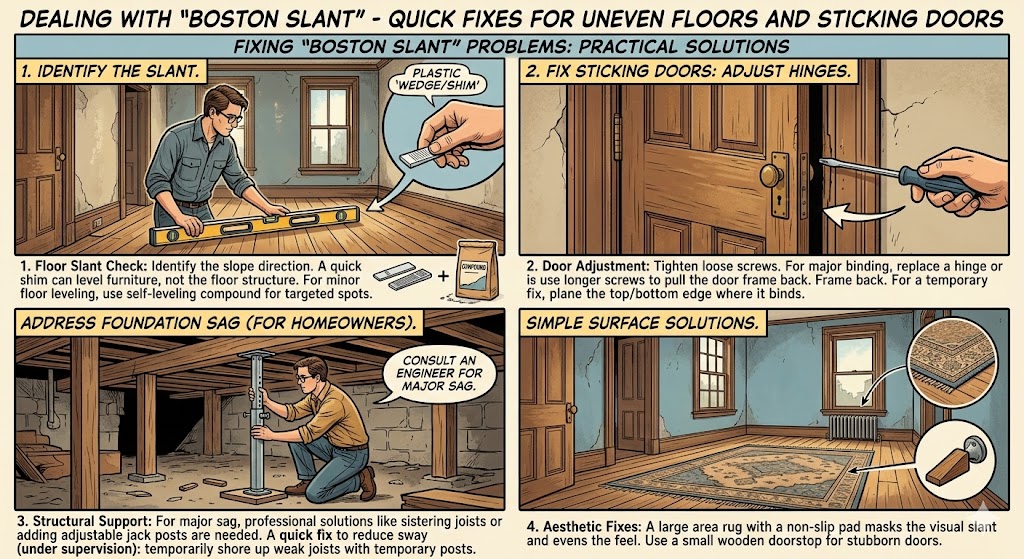
Leveling uneven floors stops sticking doors and prevents worsening structural issues; you can shim, plane thresholds, or sister joists, but seek professional repair for major shifts and address collapse risk immediately to keep your home safe.
Key Takeaways
Boston Slant describes uneven floors and misaligned door frames caused by settling or slight foundation shifts.
Simple door fixes include tightening hinges, adding shims behind hinge plates, or planing the door edge to stop sticking.
Floor low spots can be smoothed with self-leveling compound for small depressions or plywood sleepers for larger areas.
Use a long level or laser level to identify slope and mark high/low points before cutting, shimming, or applying leveling products.
Call a structural professional if gaps exceed about 1/2 inch, multiple doors stick after fixes, or cracks indicate ongoing foundation movement.
Diagnostic Steps for Assessing Floor Levelness
Begin by confirming slope with a long level or straightedge across multiple runs; you should mark where the tool rocks or gaps appear. You must log door clearances and any visible sag, as these can indicate structural issues or trip hazards that go beyond cosmetic fixes.
Utilizing Laser Levels and Plumb Bobs
Use a laser level on a tripod to establish a horizontal reference plane and sweep it across the room so you can compare heights at consistent points. You can suspend a plumb bob to verify true vertical at walls and posts, and these tools give accurate readings that reveal tilt, twist, or settlement.
Identifying High and Low Points Across the Span
Walk the span with a 6-8 ft straightedge or long level, noting where it rocks or gaps; mark high spots that lift the edge and low spots that trap the straightedge. You should flag any areas creating door binding or floor bounce since those are the most likely to need corrective action.
Measure gaps under the straightedge every 2-3 ft and map the values to build a height profile across the span; this shows whether issues are localized humps, continuous slope, or a twist. Keep a simple sketch so you can target shimming, sanding, or joist work efficiently.
Record the maximum deviations and compare them to practical tolerances; deviations over about 1/4 inch in 6 feet frequently require more than surface fixes and may need structural repair or joist adjustment. You should prioritize areas near thresholds and heavy-traffic paths for remediation.
Remedying Sticking and Misaligned Doors
You can often correct sticking by identifying hinge misalignment and top-to-bottom binding; insert a thin shim behind the lower hinge to tilt the jamb and test swing until gaps look even, and drive a longer screw into the frame for permanent alignment, as stripped screw holes will worsen misalignment.
Measure the reveal around the door after each tweak and check for rubbing at the head or latch side; you should snug screws without over-tightening and replace bent hinges or use ball-bearing hinges to restore smooth operation.
Adjusting Hinge Tension and Depth
Loosen the hinge screws slightly, pivot the door to locate binding, and add or remove thin washers (hinge shims) to set depth; you can make precise corrections that prevent scraping and keep the latch aligned.
After each change, tighten progressively and test swing; if barrels bind or hinge faces are worn, you should swap in higher-quality hinges to reduce wear and limit damage to the jamb.
Strategic Planing and Trimming for Clearance
Plane the sticking edges in short passes, marking high spots with a pencil and working with the grain to avoid tear-out; you should use a sharp block plane and check the fit often.
Trim the bottom sparingly—only when the floor gap forces it—cutting a little at a time and reinstalling the door to confirm clearance while maintaining proper weather sealing.
Protect the jamb finish with tape and wear eye and dust protection while planing; if you need to remove more than about 3/16", take the door to a shop for a professional re-cut to avoid weakening the stile, because over-cutting can ruin the door.
Determining When to Seek Professional Intervention
When you notice persistent door binding, floors tilting noticeably, or gaps between walls and trim that widen over time, escalate beyond quick fixes. You should call a pro if you spot wide or growing foundation cracks, visible joist sag, or repeated settlement after patching—these point to structural issues that need engineering assessment.
Recognizing Signs of Significant Structural Subsidence
Watch for patterns such as diagonal cracks over openings, stair-step mortar fractures, or new separation between chimneys and exterior walls. You should track change over weeks; rapid movement or widening cracks indicate active subsidence and require immediate professional inspection.
Evaluating Load-Bearing Wall Integrity
Inspect load-bearing walls for continuous cracks, bowing, or sagging at beam junctions, especially where floors slope toward the wall. If you find cracked beam ends or compromised lintels, restrict loads in that area and arrange a structural evaluation.
Engage a licensed structural engineer to perform load calculations and propose fixes; having temporary shoring or professional underpinning in place can protect you and your home while permanent repairs are planned.
To wrap up
Upon reflecting, you can tackle Boston Slant with simple checks and targeted fixes: shim low joists, plane or sand sticking door edges, use adjustable hinges, and add threshold shims to close gaps. A floor-leveling compound or sistering joists provides longer-term correction if settling continues. You save time and prevent major repairs by addressing problem spots early and testing door swings after each adjustment.
Need a hand with that stubborn slant?
Whether it's quick door adjustments or serious floor leveling, GoHandyFix has the experienced team to get your home back on solid ground. Contact us for a free consultation and keep your Boston home safe and level.
Related Services
Get Your Free Quote
Ready to fix that sloping floor or stuck door? Let our experts restore your home's comfort.